


Direct Thermal vs. Thermal Transfer Labels: How to Choose the Right Label
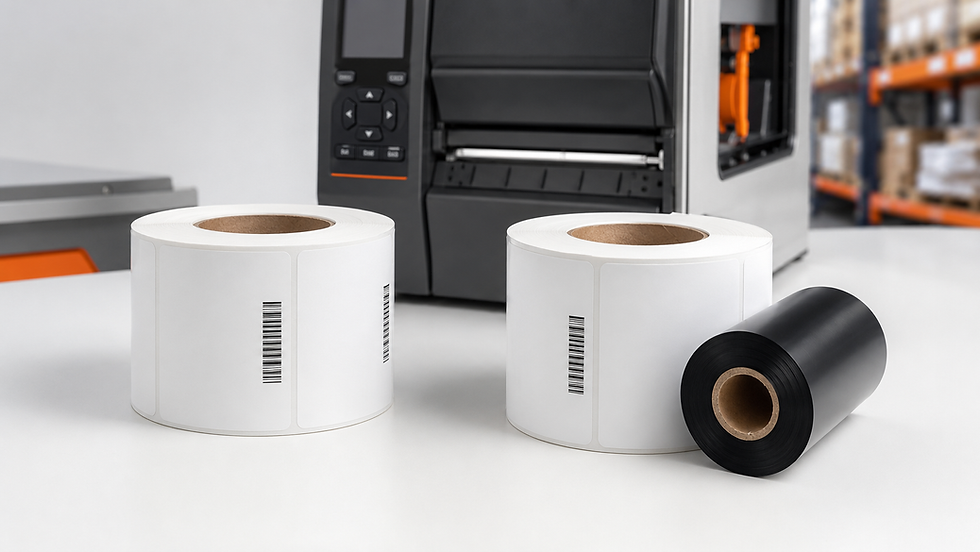
Direct thermal and thermal transfer labels may look similar, but they are designed for different applications. Choosing between them affects print durability, barcode readability, operating costs, and how well the label performs in its actual environment.
The right choice is not simply about label size. It depends on the printer, label material, adhesive, expected label life, application surface, environmental exposure, and—when thermal transfer printing is used—the printer ribbon.
What Are Direct Thermal Labels?
Direct thermal labels have a heat-sensitive surface that darkens when it passes beneath the printer’s thermal printhead. They do not require ink, toner, or a thermal transfer ribbon.
This makes direct thermal printing a straightforward option for labels that only need to remain readable for a limited time.
Common applications include:
Shipping labels
Packing and fulfillment labels
Short-term barcode labels
Retail price and weight labels
Food rotation labels
Receipts and tickets
Temporary inventory identification
Direct thermal labels perform best in controlled environments. Heat, sunlight, abrasion, moisture, and certain chemicals can cause the material to fade, darken, or become difficult to scan over time.
For a shipping label that will be used and discarded quickly, direct thermal may be exactly what is needed. For long-term identification, another material may be the better choice.
What Are Thermal Transfer Labels?
Thermal transfer printers use heat to transfer ink from a printer ribbon onto the label surface. This printing method can be used with paper labels as well as polyester, polypropylene, and other synthetic label materials.
Thermal transfer printing is commonly selected when the printed image or barcode must remain readable for an extended period or withstand more demanding conditions.
Typical applications include:
Product identification labels
Manufacturing and industrial labels
Warehouse rack and bin labels
Asset tracking labels
Inventory control labels
Automotive component labels
Outdoor labels
Chemical-resistant labels
High-temperature labels
Long-term barcode labels
The performance of a thermal transfer label depends on the complete combination of label material, adhesive, printer, and ribbon. A durable synthetic label will not perform as intended if it is paired with the wrong ribbon.
Direct Thermal or Thermal Transfer?
Direct thermal labels are generally best for short-term applications where speed and simplicity matter and the label will not face prolonged environmental exposure.
Thermal transfer labels are generally better when the application requires:
Longer label life
Greater resistance to smudging or abrasion
Exposure to moisture, oils, cleaners, or chemicals
Outdoor use
Synthetic label materials
Long-term barcode readability
Durable product, asset, or warehouse identification
Neither printing method is automatically better for every application. The correct choice is the one that matches how the label will actually be printed, applied, handled, stored, and used.
Choosing the Correct Thermal Transfer Ribbon
Thermal transfer ribbons are available in different formulations. Ribbon selection should be based on the label material and the level of print durability required.
Wax Ribbons
Wax ribbons are commonly used with paper labels for general-purpose barcode printing, shipping, inventory, retail, and warehouse applications.
Wax/Resin Ribbons
Wax/resin ribbons provide greater smudge and abrasion resistance than standard wax ribbons. They are often paired with coated paper labels and certain synthetic materials.
Resin Ribbons
Resin ribbons are commonly used with synthetic labels when the printed image must resist chemicals, moisture, abrasion, outdoor exposure, or demanding operating conditions.
The ribbon must also match the printer’s specifications, including width, length, winding direction, core size, and printing technology.
Information to Gather Before Requesting a Quote
Providing the following details can make it easier to identify the right label and ribbon combination:
Label width and height
Required quantity
Printer brand and model
Direct thermal or thermal transfer printing method
Paper or synthetic label material
Application surface
Indoor or outdoor use
Temperature and moisture exposure
Chemical or abrasion resistance requirements
Expected label life
Current label or ribbon part number, if available
If all the specifications are not known, describe the application and provide the information you have. A current label sample, printer model, photograph, or existing part number can often help narrow the options.
Get the Label, Adhesive, and Ribbon Working Together
A label can be the correct size and still fail because the material does not suit the environment, the adhesive does not match the surface, or the ribbon does not produce a durable image.
SPE Labels supplies custom and stock direct thermal labels, thermal transfer labels, barcode labels, warehouse labels, industrial labels, and thermal transfer printer ribbons. We help customers evaluate the application details before the order is placed so the components work together.
SPE Labels is an ISO 9001:2015 certified company and a certified Women’s Business Enterprise.
Visit SPELabels.com to request a quote for direct thermal labels, thermal transfer labels, barcode labels, or printer ribbons.


Comments